|
|
|
|
|
|
|
|
|
 |
CONTACT EMAIL KILLERCOP @ KILLERCOP.COM |
|
||||||
 |
 |
 |
|
 |
|
|
||
 |
|
|||||||
|
(excerpted from The Manual for Complex Litigation, '95 ed.) 20.1 Judicial Supervision 20.11 Early Identification and Control 20.12 Assignment to Single Judge 20.121 Recusal/Disqualification 20.122 Other Judges 20.123 Related Litigation 20.13 Effective Management 20.14 Supervisory Referrals to Magistrate Judges and Special Masters Fair and efficient resolution of complex litigation requires that the court exercise early and effective supervision (and, where necessary, control), that counsel act cooperatively and professionally, and that the judge and counsel collaborate to develop and carry out a comprehensive plan for the conduct of pretrial and trial proceedings. Section 20 discusses matters that cut across all phases of complex litigation. Although not without limits, the court's express and inherent powers enable the judge to exercise extensive supervision and control of litigation. The Federal Rules of Civil Procedure, particularly Rules 16, 26, 37, 42, and 83, contain numerous grants of authority that supplement the court's inherent power -fn.2 to manage litigation. Fed. R. Civ. P. 16(c)(12) specifically addresses complex litigation, authorizing the judge to adopt "special procedures for managing potentially difficult or protracted actions that may involve complex issues, multiple parties, difficult legal questions, or unusual proof problems." In planning and implementing case management, its purpose must be kept in mind. Case management is not an end in itself; rather it is intended to bring about a just resolution as speedily and inexpensively as possible. It should be tailored to the needs of the particular litigation and to the resources available; make-work activity should be avoided. Those resources include not only those of the parties but also those of the judicial system. Judicial time is the scarcest of these, and an important part of case management is for judges to use their time wisely and efficiently and to make use of all available help. Time pressures may lead some judges to think that they cannot afford to devote time to civil case management. It is true that the extra attention given by the judge to a complex case can encroach upon the time immediately available to attend to other matters. But judges have found that an investment of time in case management in the early stages of the litigation will lead to earlier dispositions, less wasteful activity, shorter trials, and, in the long run, to economies of judicial time and a lessening of judicial burdens. "Only one tribunal ever adopted a practice of forcing counsel upon an unwilling defendant in a criminal proceeding. The tribunal was the Star Chamber."-U.S. v Faretta, 422 U.S. 806 (1975) REASONABLE DOUBT DIRTY SECRETS AND MENTAL TORTURE TREATMENTS TO RESTORE YOUR MIND. (c) 1995-2026 |
Stipulation to Continue Trial Date And Exclude Time, filed by AUSA and counsel Potashner, cites as Ground #1 that "The Case is Complex" at page 2. Id. 14 MONTH LATER Transcript of 09.26.03 Page 31, Lines 18-22
[Considering the technically complex nature of the evidence held against him, Sutcliffe clearly had a compelling interest in personally reviewing the entire electronic discovery in this case. The mere fact that counsel "represented" Sutcliffe does little to ensure him effective assistance of counsel due to the specialized nature of the evidence. Sutcliffe can only receive effective assistance of counsel if his attorney is able to first, actually review the discovery in confidence and, secondly, consult with someone who can understand and explain the nature of the evidence, be it an expert and/or the defendant personally.] (SEE OCT. 1, 2003 TRANSCRIPT)
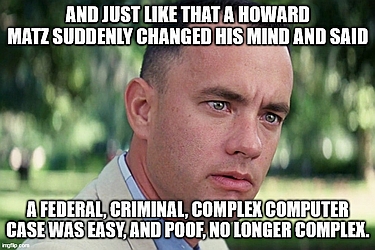
Where the judge grants a continuance based upon a finding of case complexity, specific findings must be made. United States v. Clymer, 25 F.3d 824, 828-29 (9th Cir. 1994) (criticizing the trial court for an open-ended declaration of complexity as well as for a retroactive invocation of the "ends of justice" basis for delay). At neither arraignment did the government file a complex case form, as required by law. Nor did the government file the vital Certificate of Restoration, as required by the law. This was never filed as a complex case, though the AUSAand Judge both used that excuse to delay defendant’s trial over his objections back in 2002. See Reeds comments 09.02.03 as well, since he was worried this was a complex case and did not want to be appointed as standby counsel under such a case, with about 4 weeks until trial. Suddenly, it became uncomplex. The record does not show anywhere the court ever designating the case a "complex case." In fact, the judge said he believed a lawyer with no computer skills at all could handle the case. The judge states this because David Reed, when asked if he could handle the case commented, "Well, that I’m not absolutely certain about." If the case is not too complex, then I certainly can be. There’s one month to go before that date approximately and I intend on studying the case, analyzing it. I would like, of course, to speak with Mr. Sutcliffe. The record further shows Reed never had the opportunity to speak before the judge sua sponte appointed him. See 11.21.02, judge’s comments of "I’m in the same boat as you," while discussing computer understanding. The public Pretenders took over 6 months and still wanted more time until it was necessitated to remove them. Reed clearly didn’t want to be appointed if the case was complex. Reed later had a scowl on his face, when forced to proceed as counsel of record after the judge admits he denied counsel for defendant, illegally and unlawfully, for 9 months! SURPRISE! THAT WAS NOT THE ONLY UNLAWFUL AND ILLEGAL THING HE WAS DOING. Suspicion that viewpoint discrimination is afoot is at its zenith when the speech restricted is speech critical of the government," Ridley v. Mass. Bay Transp. Auth., 390 F.3d 65, 86 (1st Cir. 2004) FILE A COMPLAINT
TO PURCHASE KILLERCOP.COM™ EMAIL SALES @ KILLERCOP.COM (c) 1995-2026 | |
||||||
|
|
|||||||